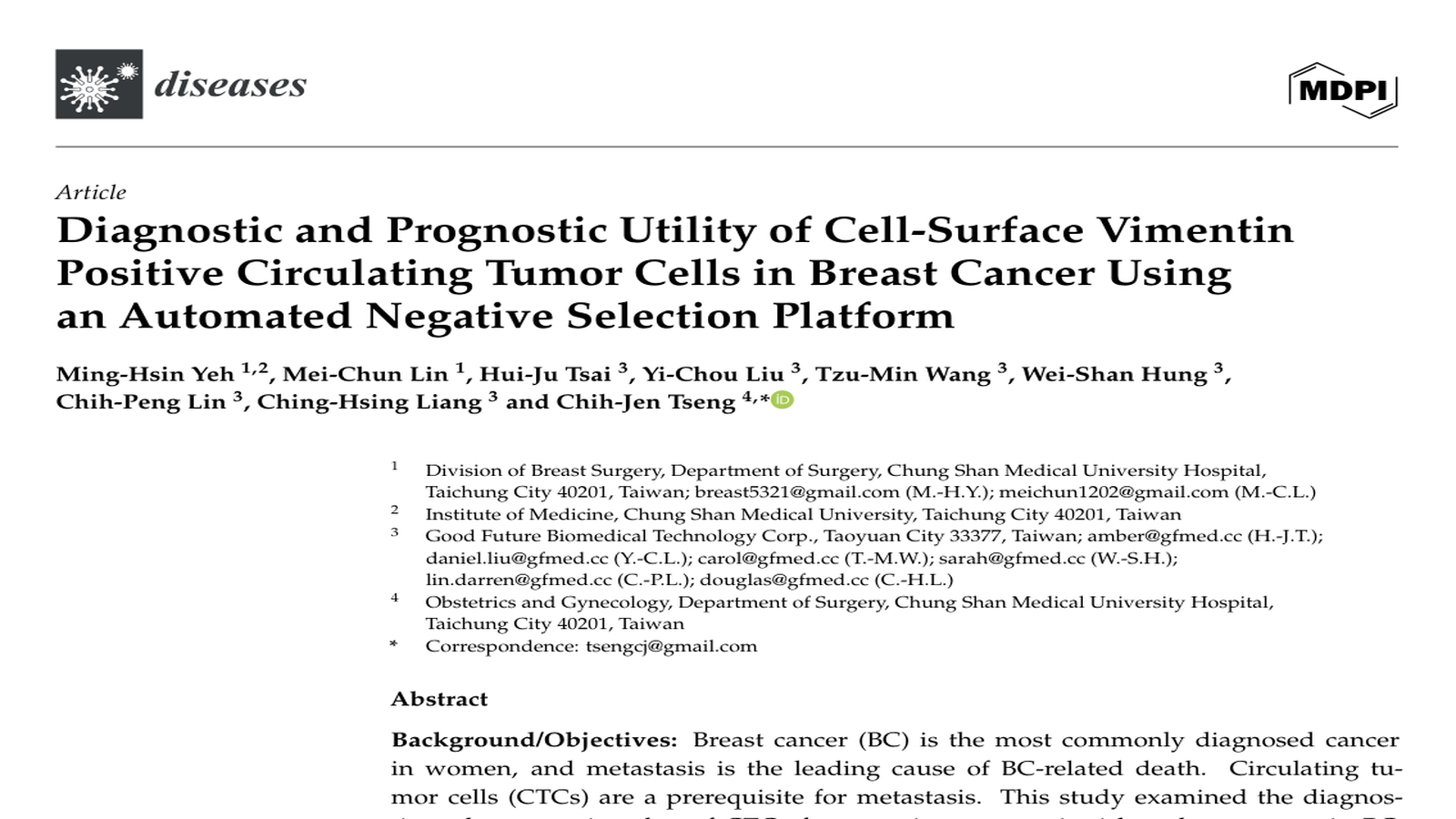
Good Future and Chung Shan Medical University Hospital have recently published a breast-cancer circulating tumor cell (CTC) study in MDPI Diseases. The paper is titled Diagnostic and Prognostic Utility of Cell-Surface Vimentin Positive Circulating Tumor Cells in Breast Cancer Using an Automated Negative Selection Platform.
The study used the Chiline CATCH® automated negative selection platform to enrich and enumerate CTCs from peripheral blood samples collected from patients with breast cancer. EpCAM and cell-surface vimentin (CSV) were used as the primary identification markers.
The main finding was that CSV+ CTC counts, rather than EpCAM+ CTC counts, increased in patients at higher metastatic risk. Using a cut-off of more than 4.5 CSV+ CTCs per 2 mL of blood, the assay showed a sensitivity of 0.56 and a specificity of 0.92 for identifying patients with higher metastatic risk.
The paper also reported that CSV+ CTCs outperformed conventional serum tumor markers such as CA 15-3, CA 125, and CEA in identifying patients with high metastatic risk. When combined with those markers, the overall risk-stratification performance improved further. In addition, CSV+ CTC counts of 5 cells or more per 2 mL of blood were significantly associated with worse progression-free survival.
These results highlight the value of an automated negative selection platform in retaining clinically meaningful CTC phenotypes and suggest that CSV+ CTCs may serve as a useful biomarker for metastatic-risk stratification and recurrence monitoring in breast cancer.
The original paper was published online on 3 April 2026 and is available at https://doi.org/10.3390/diseases14040130.